AI maturity is an organization’s ability to turn AI into repeatable business value — through the data, governance, people, and operating model that make it work. An AI maturity model gives leadership a way to assess that capability, from scattered experiments to AI embedded in how the business operates. At F1, the test is not how much AI you use. It is whether your AI compounds.
Ask a leadership team how their AI transformation is going and you'll get a number: how many pilots are running, how many licenses are deployed, how many teams are “using AI.” Ask what any of it changed about the business, and the room goes quiet.
That gap — between activity and result — is the most reliable signal of where an organization actually sits on the AI maturity curve. The F1 AI Maturity Scale below makes that gap visible — and gives the C-suite a way to decide what to build next.
Maturity is a performance question, not a technology one
This isn't a soft observation. In December 2024, MIT's Center for Information Systems Research — Peter Weill, Stephanie Woerner, and Ina Sebastian — mapped enterprises across four stages of AI maturity and found something that belongs in front of a board: companies in the lower stages performed below their industry average, while those in the upper stages performed above it. Only 7% had reached the top.
Maturity tracks with financial performance. It is not a score for the CIO to manage; it's a competitiveness question the C-suite owns.
The F1 AI Maturity Scale
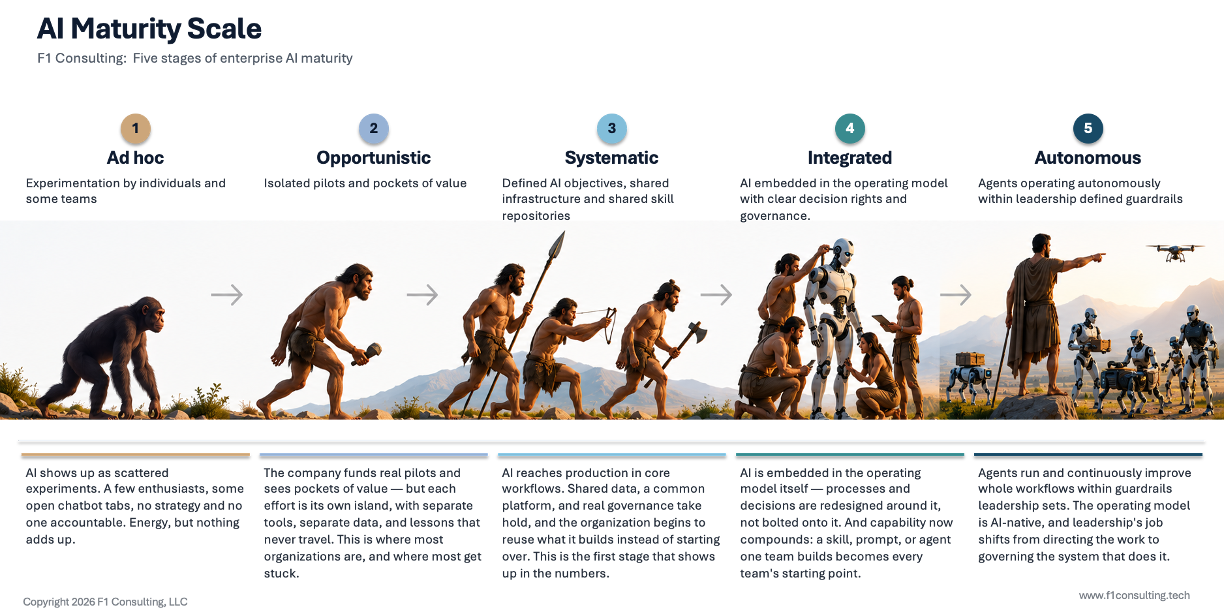
We use a five-stage scale with clients, from ad hoc to autonomous.
1. Ad hoc. AI shows up as scattered experiments. A few enthusiasts, some open chatbot tabs, no strategy and no one accountable. Energy, but nothing adds up.
2. Opportunistic. The company funds real pilots and sees pockets of value — but each effort is its own island, with separate tools, separate data, and lessons that never travel. This is where most organizations are, and where most get stuck.
3. Systematic. AI reaches production in core workflows. Shared data, a common platform, and real governance take hold, and the organization begins to reuse what it builds instead of starting over. This is the first stage that shows up in the numbers.
4. Integrated. AI is embedded in the operating model itself — processes and decisions are redesigned around it, not bolted onto it. And capability now compounds: a skill, prompt, or agent one team builds becomes every team's starting point.
5. Autonomous. Agents run and continuously improve whole workflows within guardrails leadership sets. The operating model is AI-native, and leadership's job shifts from directing the work to governing the system that does it.
How to assess your organization’s AI maturity
Start with a real workflow, not a company-wide average. Choose work that matters to the business — serving a customer, making a decision, or delivering a product — and bring together the people who own the outcome, the technology, and the risk. Assess what happens in production today, not what the roadmap promises.
Use five questions to separate capability from activity:
- Value: what changed? Look for a measured change in cost, cycle time, quality, or customer outcomes against a baseline. Licenses purchased and pilots launched are activity measures, not evidence of value.
- Data and technology: can it work reliably? Can the workflow access the data it needs, at the quality and permissions it requires? Look for production use and shared foundations, not a demo that depends on one person’s workaround.
- Governance: who owns the result? Name the accountable owner, the limits on AI decisions, and what happens when the system fails. Find evidence of monitoring, human review, and an escalation path where the stakes require them.
- People and process: did the work actually change? Check whether teams use AI in the live workflow, whether responsibilities have changed, and whether people can challenge or correct its output. A tool added to an unchanged process is not an operating-model transformation.
- Reuse: does one team’s progress travel? Look for skills, prompts, agents, and lessons that other teams can adopt and improve. If every initiative starts from zero, capability is not yet compounding.
Match that evidence to the five stages. Isolated experiments point to Ad hoc; funded but disconnected pilots to Opportunistic; repeatable production workflows with shared foundations to Systematic. Integrated means the operating model has changed and capability travels across teams. Autonomous requires whole workflows operating and improving within explicit guardrails — not simply access to an agent.
Different parts of the business can sit at different stages. Do not let one strong pilot stand in for the enterprise. Where evidence is missing, record the gap rather than invent a score. Then choose the next capability to build, give it an owner, and agree on the business result that would demonstrate progress. The scale is a decision tool, not a badge.
The wall almost everyone hits
MIT found the performance divide at exactly the crossing this scale marks: between Stage 2 and Stage 3 — between running pilots and industrializing them. That's the wall, and most organizations are stacked against it.
What stops them is almost never the technology. Harvard Business Review has been blunt: companies run too many pilots and finish too few, and the blocker is what its researchers call the “last mile” — the organizational work of getting AI into how people actually operate. Legacy processes, undocumented tribal knowledge, missing governance, no shared platform. The model was the easy part.
Which is why “more pilots” is not a strategy. A hundred disconnected experiments is a Stage 2 activity, no matter how good the demos.
What actually moves you up
Three things separate the organizations that climb from the ones that plateau.
Your AI has to compound. The gap between Stage 3 and Stage 4 isn't more use — it's reuse. If every team re-solves the same problems from zero, maturity grows by addition and stalls. When improvements are captured and shared — a library of skills, prompts, and agents the whole organization draws from — capability multiplies, and every gain made once is inherited everywhere. Compounding, not volume, is the engine.
The operating model is a moving line, not a one-time redesign. The division of labor between humans and AI isn't a boundary you draw once and file away. Every time the models improve — now every few months — the line moves, and work that belonged to people last quarter can shift to a system this quarter. Mature organizations treat the operating model as living, revisited on a cadence, not a program with an end date.
Higher isn't always the goal. The urge to push every process toward full autonomy is a mistake, and the market knows it: by late 2025, only about 6% of companies said they fully trusted AI agents to run core processes, per research reported by Harvard Business Review. Maturity isn't maxing the scale everywhere — it's choosing the right stage for each part of the business: automating what should be automated, keeping human what should stay human, granting autonomy only where it's earned and governed. Knowing where not to use AI is a mark of maturity, not timidity.
So — how mature are you, really?
Not how many pilots you're running. Not how many seats you've bought. Ask instead: when one team gets better at using AI, does the rest of the company get better too? Is your operating model keeping pace with the models themselves? And do you honestly know which stage each part of your business is on?
Maturity isn't how much AI you use. It's whether your AI compounds — the difference between the organizations pulling ahead of their industry and the ones quietly falling behind.
For a starting point for that leadership conversation, take the F1 AI-Native Enterprise Diagnostic. It takes three to five minutes and provides an initial leadership readout on the gap between the company you operate today and the company you would design in the context of AI. It is not a maturity rating or a comprehensive audit; use it alongside the scale to sharpen the questions your leadership team needs to answer next.